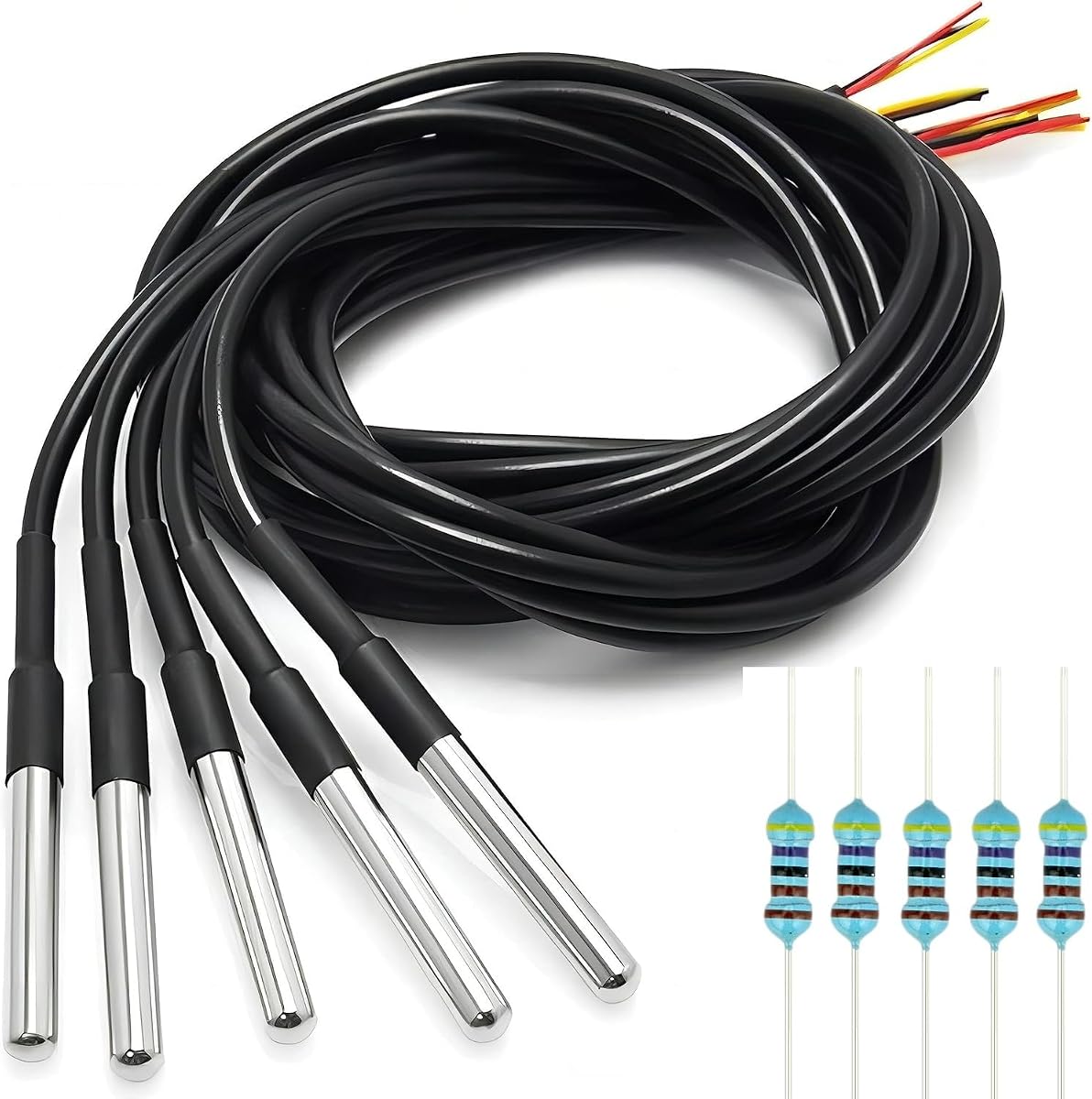
WWZMDiB 5 Pcs DS18B20 Temperature Sensor Probe
4.4Editor score
Waterproof stainless probe
Wide temp range
Includes resistors
This guide compares the top ten Arduino temperature sensor modules for accuracy range and ease of use to help you select the perfect device for your project
Selecting the right Arduino temperature sensor is crucial for any electronics project involving environmental monitoring or thermal control. Whether you are building a weather station or a smart home device, the sensor you choose will define the accuracy and reliability of your entire system.
We have evaluated ten leading options based on precision, voltage compatibility, communication protocols, and user feedback. This list covers digital and analog modules, waterproof probes, and humidity-capable units to ensure you find the exact fit for your specific technical requirements.
Each pick below highlights key specifications and ideal use cases to streamline your decision process. Please note that product availability and pricing can fluctuate frequently, so always verify the latest details on the retailer page before making your final purchase decision today.
4.4Editor score

4.5Editor score

4.9Editor score
The following table provides a side-by-side comparison of all ten selected Arduino temperature sensor modules. Review the specs to quickly identify which device matches your voltage, range, and interface needs.


The HiLetgo 5pcs DHT11 module stands out as a highly accessible option for beginners and experts alike. With a solid rating of 4.5 stars, it offers a reliable digital output that simplifies integration with your microcontroller projects.
We may earn a commission when you buy through this link, at no additional cost to you.
This sensor utilizes a pre-calibrated digital output system with a single-wire scheme. The inclusion of a bypass capacitor and pull-up resistor on-board reduces external component needs and greatly reduces programming effort for standard Arduino setups.
While the humidity measurement range is limited to 20 to 95 percent and accuracy is plus or minus 5 percent, these trade-offs are acceptable for general indoor monitoring. The temperature range of 0 to 50 degrees Celsius covers most ambient environmental needs.
You should buy this if you need multiple sensors for different locations at a low cost. It is the ideal choice for weather stations or home automation where high precision is not critical but reliability and ease of use are paramount.
The single bus digital signal interface allows for quick connections to microcontroller IO ports without complex circuitry.
Long term stability of less than plus or minus 1 percent RH ensures consistent readings over time.
We may earn a commission when you buy through this link, at no additional cost to you.
The 2pcs AHT30 High Precision module is an excellent budget-friendly option that delivers exceptional performance. It boasts a perfect 5.0 rating and utilizes I2C communication to streamline connections in crowded breadboard setups.
We may earn a commission when you buy through this link, at no additional cost to you.
This upgraded version supports simultaneous online access to multiple devices via the I2C bus. The voltage range of 2.0V to 5V makes it adaptable to many different microcontroller logic levels without additional regulators.
Temperature accuracy of plus or minus 0.3 degrees Celsius is impressive for a low-cost sensor. While it requires I2C pins which might be scarcer than digital pins, the stable and fast transmission speed justifies the slight complexity.
Buy this if you need high precision without spending much money. It is perfect for environmental monitoring where humidity and temperature data must be accurate and reliable across various supply voltages.
I2C master output simplifies wiring by reducing the number of data lines required for each sensor.
Wide supply voltage range ensures compatibility with both 3.3V and 5V logic systems easily.
We may earn a commission when you buy through this link, at no additional cost to you.
The Teyleten Robot SHT31-D module is a premium choice for projects demanding high accuracy and wide operating conditions. With a 4.7 rating, it offers robust performance suitable for industrial or demanding environmental applications.
We may earn a commission when you buy through this link, at no additional cost to you.
This sensor supports a wide voltage range from 2.4V to 5.5V, making it incredibly flexible. The temperature measurement range extends from -40 to 125 degrees Celsius, covering extreme conditions that standard sensors cannot handle.
Humidity accuracy is plus or minus 2 percent RH which is very reliable. The I2C interface is standard and easy to implement. While it may cost slightly more than basic options, the precision and range justify the investment.
You should choose this for professional prototypes or outdoor installations. Its ability to handle extreme temperatures and maintain high accuracy makes it the best premium option for serious hobbyists and engineers.
Supports operation from -40 to 125 degrees Celsius allowing for extreme environment testing.
Humidity measurement accuracy of plus or minus 2 percent RH ensures reliable climate data.
We may earn a commission when you buy through this link, at no additional cost to you.
The Gikfun 1M DS18B20 sensor is designed for environments where moisture is a concern. Rated at 4.4 stars, it features a waterproof probe that can be safely submerged or placed in damp locations for monitoring.
We may earn a commission when you buy through this link, at no additional cost to you.
This module comes with a pluggable adapter board that simplifies connections to microcontrollers. The 1 meter cable length provides flexibility in placement, allowing you to place sensors far from your main board.
The temperature range spans from -55 to 125 degrees Celsius which covers most industrial needs. While it does not measure humidity, its single bus interface makes it easy to chain multiple probes for distributed monitoring.
Buy this for fish tanks or greenhouses where humidity and water contact are expected. The waterproof design and long cable make it a practical solution for remote thermal monitoring tasks.
Waterproof probe allows for safe usage in wet environments without damage to internal components.
1 meter cable enables flexible placement of sensors away from the control electronics.
We may earn a commission when you buy through this link, at no additional cost to you.
The WWZMDiB 5 Pcs DS18B20 pack offers great value for DIY projects requiring multiple sensors. With a 4.4 rating, it is designed for underwater or moist environments where durability is essential.
We may earn a commission when you buy through this link, at no additional cost to you.
This kit includes five waterproof probes and five 4.7K resistors which simplifies the setup process. The supply voltage of 3 to 5.25V ensures compatibility with most modern microcontroller logic levels without extra components.
Accuracy is plus or minus 0.5 degrees Celsius across a wide range of -55 to 125 degrees. While it lacks an adapter board, the clear wiring colors make it easy to connect directly to any development board.
You should buy this if you need many sensors for a large system. The inclusion of resistors makes it a complete package for monitoring multiple zones in a home or office.
Pack includes five probes and five resistors saving time and effort on assembly.
Waterproof probes allow for operation in wet conditions without risking electrical failure.
We may earn a commission when you buy through this link, at no additional cost to you.
The 2pcs DHT11 module is a classic option known for its reliability in hobbyist projects. Rated at 4.3 stars, it uses a dedicated digital module to ensure high long term stability in varying conditions.
We may earn a commission when you buy through this link, at no additional cost to you.
The single-wire wiring scheme makes integration easy and reduces programming effort. It works with both Arduino and Raspberry Pi making it versatile. The included wires simplify setup so you can start testing immediately.
The humidity and temperature error rates are plus or minus 5 percent and plus or minus 2 degrees respectively. While this is not precision grade, it is sufficient for general comfort monitoring and basic alerts.
Buy this for simple home weather stations or school projects. Its compatibility with popular boards and simple protocol make it an excellent starting point for learning sensor integration.
Designed to work with Arduino and Raspberry Pi ensuring broad ecosystem support.
Uses calibrated digital modules to ensure stable readings over extended use periods.
We may earn a commission when you buy through this link, at no additional cost to you.
The DROK 2 Pack Waterproof DS18B20 set is the top premium choice for demanding applications. With a 4.9 rating, it features corrosion resistant stainless steel probes that survive harsh conditions and continuous submersion.
We may earn a commission when you buy through this link, at no additional cost to you.
This kit includes adapter boards with integrated pull up resistors which simplifies wiring significantly. The wires are separated with heat shrink tubing to prevent shorts and ensure safe connections to GPIO pins.
Temperature accuracy is plus or minus 0.5 degrees Celsius which is highly reliable. The voltage range of 3.0V to 5.5V allows it to work with any common microcontroller. It supports 1-Wire protocol for simple communication.
You should choose this for industrial or outdoor projects where durability is key. The included accessories make it ready for immediate use and the stainless steel housing guarantees longevity in wet environments.
Adapter boards include pull up resistors so you do not need external components for 1-Wire.
Stainless steel probes withstand rust and corrosion ensuring long term reliability in water.
We may earn a commission when you buy through this link, at no additional cost to you.
The Gikfun 5PCS 1M DS18B20 pack offers a straightforward solution for distributed sensing. Rated at 4.5 stars, these sensors use a unique single bus interface that eliminates the need for extra components.
We may earn a commission when you buy through this link, at no additional cost to you.
Each probe comes with a 100 centimeter cable giving you ample length for placement. The power supply range of 3.0V to 5.5V ensures compatibility with various microcontrollers. The wires are color coded for easy identification.
You will need to provide a 4.7K resistor between Data and VCC for easier testing. This requirement is minor and ensures stable signals. The wide temperature range supports industrial and outdoor use effectively.
Buy this for large scale monitoring where you need many sensors at once. The cable length and single bus capability make it ideal for monitoring temperatures in multiple distant locations.
100cm cable allows flexible placement away from the main controller unit.
No other components required except for a pull up resistor for stable data.
We may earn a commission when you buy through this link, at no additional cost to you.
The HiLetgo 2pcs DHT22/AM2302 module provides high sensitivity for humidity and temperature monitoring. With a 4.4 rating, it is a direct replacement for older SHT models and offers improved performance.
We may earn a commission when you buy through this link, at no additional cost to you.
The AOSONG AM2302 chip delivers accurate readings with a temperature range of -40 to 80 degrees Celsius. The fixing screw holes allow for secure mounting which is important for stationary monitoring systems.
Humidity measurement covers 0 to 100 percent RH with plus or minus 2 percent accuracy. This broad range makes it suitable for humid climates where standard sensors might fail. It is easy to install on a breadboard.
You should buy this for indoor climate control projects. Its high sensitivity and wide humidity range make it a reliable choice for greenhouses or living spaces.
AOSONG AM2302 chip ensures high sensitivity for precise humidity and temperature data.
Fixing screw holes allow secure installation on walls or panels.
We may earn a commission when you buy through this link, at no additional cost to you.
The HiLetgo 5pcs DS18B20 Temperature Sensor pack offers durable stainless steel probes for industrial use. Rated at 4.5 stars, these probes are waterproof and designed for long term deployment in wet environments.
We may earn a commission when you buy through this link, at no additional cost to you.
Power supply requirements of 3.0V to 5.5V ensure they work with most microcontrollers. The cable length of 1 meter allows for convenient placement of sensors away from the main board.
The temperature range covers -55 to 125 degrees Celsius which is suitable for most thermal monitoring needs. You will need a 4.7K resistor between Data and VCC for stable testing and operation.
Buy this for projects requiring multiple durable sensors. The stainless steel package and waterproof design make it ideal for outdoor or submerged temperature monitoring tasks.
Stainless steel package provides physical protection against impact and corrosion.
Waterproof seal ensures safe operation in wet conditions without leakage.
We may earn a commission when you buy through this link, at no additional cost to you.
Selecting the right sensor depends on your environment and specific technical requirements. This guide breaks down the key factors to consider.
Ensure the sensor covers the temperatures you expect. For indoor use, 0 to 50 degrees Celsius is sufficient. For industrial or outdoor use, look for -40 to 125 degrees.
Always check the lower and upper limits to avoid damaging the sensor in extreme conditions.
Accuracy determines how close the reading is to the true temperature. Most hobby sensors offer plus or minus 0.5 to 2 degrees. High precision needs require specialized modules.
Prioritize accuracy for scientific projects but save money on general monitoring tasks.
Interfaces like I2C, single wire, or digital bus affect wiring complexity. I2C is efficient but needs specific pins. Single wire is simple but slower.
Choose an interface that matches your board's available ports and coding experience.
If measuring in damp areas, choose a waterproof probe. Stainless steel housing provides extra durability against corrosion.
Verify the IP rating or waterproof rating to ensure safe operation in liquid.
Microcontrollers vary in logic voltage. Ensure the sensor supports 3.3V or 5V systems directly.
Wide voltage ranges simplify power supply choices and prevent component damage.
Some sensors measure both temperature and humidity. If you need relative humidity data, select a dual sensor module.
Dedicated humidity sensors often have different ranges than temperature modules.
Long cables allow you to place the sensor far from the microcontroller. Look for 1 meter cables for flexibility.
Longer cables may require signal conditioning to maintain data integrity.
Some packages include resistors or adapter boards. This simplifies setup and saves cost.
Check what is included before buying to avoid missing components.
Start by connecting the sensor to your microcontroller according to the wiring diagram. Ensure power and ground connections are secure to prevent noise in readings.
Install the necessary libraries on your computer to communicate with the sensor. Upload a basic test script to verify data output before your main project.
Avoid exposing waterproof sensors to extreme pressure. Clean dry sensors periodically to prevent dust buildup from affecting accuracy.
The AHT30 and SHT31-D offer high accuracy typically around plus or minus 0.3 degrees Celsius. For precise measurements these modules are the best choice.
Most digital sensors require a pull up resistor. Some kits include 4.7K ohm resistors so check the package contents before you start.
Yes, all listed sensors are compatible with Raspberry Pi. Just ensure the voltage levels match your GPIO pins.
The DS18B20 waterproof probe is ideal for underwater use. Ensure it is rated for the pressure you expect.
Use I2C or one wire protocols to chain multiple sensors. Each sensor will have a unique address.
Yes, humidity measurements depend on temperature. Dual sensors compensate for this automatically during operation.
You now have a complete overview of the top ten options for your project. Each sensor offers unique benefits depending on your needs for precision and durability.
Prioritize accuracy and waterproofing if your project involves harsh environments. For beginners, simplicity and cost are more important factors.
Remember that prices and stock can change quickly so verify the latest information on the product page before you buy.