
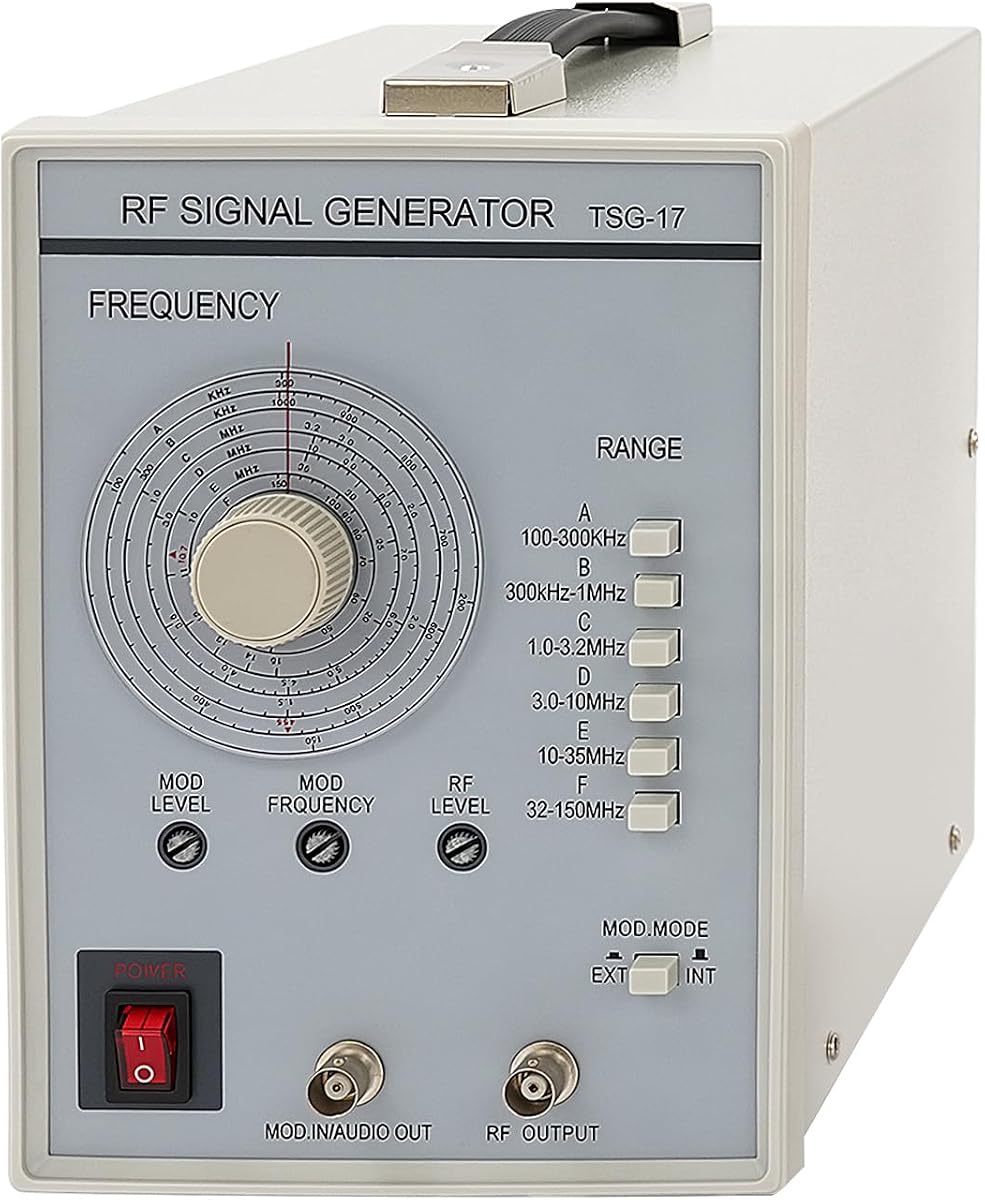
6-Band Signal Generator 100KHz-150MHz
100KHz to 150MHz range
Low phase noise output
Simple assembly-free operation
This guide compares the top Amfm Signal Generator models for 2026, evaluating frequency range, modulation types, and portability to help you choose the right
Finding the right Amfm Signal Generator is essential for engineers and hobbyists who need precise signal output for testing electronic circuits and radio equipment effectively.
We evaluated ten leading models based on frequency range, modulation capabilities, build quality, and user reviews to ensure you get reliable performance for your specific application needs.
Each pick highlights key features and trade-offs so you can make an informed decision quickly, though note that availability and pricing may vary over time on the market.

5.0Editor score

5.0Editor score
The following table provides a side-by-side comparison of all ten selected models highlighting their core specifications and unique features to help you identify the best fit for your workflow.




This handheld unit stands out as the top choice due to its impressive 60 MHz range and robust dual-channel capabilities which are rare in this size.
We may earn a commission when you buy through this link, at no additional cost to you.
The inclusion of AM, FM, PM, and FSK modulations makes it versatile for radio testing while the high sample rate ensures clean waveform generation.
Though it costs more than basic models, the precision and flexibility justify the investment for serious engineers who need reliable field testing equipment.
Anyone needing a portable yet powerful tool for complex signal analysis will find this device meets their needs without sacrificing performance or quality.
Its mini palm-sized design allows easy transport to job sites while maintaining full benchtop functionality for diverse signal testing tasks.
Supporting multiple modulation types in one device eliminates the need for separate tools when testing receivers that require different signal profiles.
We may earn a commission when you buy through this link, at no additional cost to you.
This model offers an entry level solution for those needing basic AM and FM signals without the high cost of advanced digital waveform generators.
We may earn a commission when you buy through this link, at no additional cost to you.
The low phase noise ensures signal purity which is critical for testing radio equipment even if the interface remains analog and simple to use.
Build quality is solid with scratch resistant materials ensuring it withstands daily lab use while remaining easy to operate for beginners.
Ideal for hobbyists or schools needing a reliable source for basic tuning exercises without breaking the budget or requiring complex setup procedures.
High-class metal and plastic spraying processes make this unit impact resistant and long lasting for environments with frequent handling or transport.
The division into six bands allows precise selection across the 100KHz to 150MHz range for various radio frequency testing scenarios.
We may earn a commission when you buy through this link, at no additional cost to you.
This premium unit combines seven functions into one device offering unparalleled versatility for engineering teams needing diverse signal types in a single setup.
We may earn a commission when you buy through this link, at no additional cost to you.
The fully independent dual channels allow phase adjusted output making it perfect for testing differential circuits and synchronous communication systems effectively.
With 60 built-in arbitrary waveforms and 14-bit resolution you get precise control over signal shape and quality without external programming tools.
Investing in this model pays off for R&D labs that require high accuracy and flexibility across multiple testing protocols without buying separate instruments.
Two equal-performance channels with adjustable phase difference enable complex circuit testing that single-channel generators simply cannot support effectively.
The 2.4-inch TFT LCD shows real-time waveforms and parameters clearly ensuring users can monitor changes instantly during configuration.
We may earn a commission when you buy through this link, at no additional cost to you.
This unit balances performance and portability with a 35MHz output and 14-bit resolution that suits general lab testing and educational purposes effectively.
We may earn a commission when you buy through this link, at no additional cost to you.
The large TFT LCD makes it easy to view waveforms and settings while the 150 built-in arbitrary waveforms provide ample variety for standard tests.
PC connectivity allows remote control which is convenient for automated test sequences though the 35MHz limit may restrict high frequency RF work.
Engineers needing a reliable function generator for mixed signals and digital modulation will find this model offers strong value and solid performance.
The 3.6 TFT color screen displays real-time status and menus clearly helping users adjust parameters without guesswork or confusion.
Support for remote control via USB enables integration into larger automated test setups reducing manual intervention during repetitive tasks.
We may earn a commission when you buy through this link, at no additional cost to you.
This model extends frequency coverage up to 4400MHz making it suitable for testing equipment across a broad RF spectrum without requiring multiple devices.
We may earn a commission when you buy through this link, at no additional cost to you.
The power off memory feature ensures settings are retained so you can restart quickly without re-entering parameters every time you use it.
Though the wave forms are basic sine waves with some noise the wide range and portability make it a good backup for field work.
Users focused on broad frequency sweeps rather than precision waveform generation will find this kit a practical addition to their testing arsenal.
Covering from 35MHz to 4400MHz allows testing of microwave components and modern communication modules that lower range units cannot reach.
Being powered by a mobile charger or power bank means you can operate it anywhere without needing a wall outlet or fixed power source.
We may earn a commission when you buy through this link, at no additional cost to you.
This generator focuses on delivering accurate RF and AM signals for commercial and household applications where simplicity and reliability are the main priorities.
We may earn a commission when you buy through this link, at no additional cost to you.
The external modulation signal input allows you to modify the output using other sources adding flexibility without complicating the internal design.
It covers 100kHz to 150MHz which is sufficient for AM radio testing but may lack the modulation depth needed for complex modern protocols.
If you need a straightforward high accuracy source for basic tuning and don't require arbitrary waveforms this unit offers a direct solution.
High accuracy signal generation ensures consistent output levels for testing amplifiers and receivers where stability matters most during measurements.
Output control ranges from 1mV to 100m giving you flexibility to test sensitive inputs without overdriving the circuit under evaluation.
We may earn a commission when you buy through this link, at no additional cost to you.
This device targets industrial automation needs providing precise voltage and current outputs that mimic real sensor signals for PLC and control testing.
We may earn a commission when you buy through this link, at no additional cost to you.
The 4-20mA current standard is essential for process control loops and this generator makes it easy to simulate those conditions without physical transducers.
Built-in battery and short circuit protection ensure it remains safe and usable in the field even if power outlets are unavailable during maintenance.
Professionals working with industrial control systems will find this tool indispensable for calibrating transmitters and verifying system responses reliably.
Simulating 4-20mA signals allows technicians to verify control logic without needing to install actual field devices on the loop.
Short circuit and reverse connection protection prevent damage to both the generator and the device under test during accidental wiring errors.
We may earn a commission when you buy through this link, at no additional cost to you.
This compact unit excels in portability and precision offering 0.01V resolution that is vital for calibrating sensitive control panels and valves.
We may earn a commission when you buy through this link, at no additional cost to you.
The four-digit display allows quick switching between voltage and current modes making it versatile for different types of industrial signal verification tasks.
Users can set fast signal output points for repeated tests saving time during routine maintenance while the rechargeable battery ensures independence from outlets.
For field technicians needing a reliable pocket-sized tool for PLC debugging and sensor simulation this model offers the right balance of size and function.
With 0.01V and 0.01mA precision you can detect and correct minor deviations in control systems that broader tolerance tools might miss.
Powering via micro USB or external DC ensures the device keeps running even if the internal battery is low or unavailable for the job.
We may earn a commission when you buy through this link, at no additional cost to you.
This advanced model supports a wide array of signal types including voltage current and pulse outputs which makes it ideal for complex PLC and automation testing.
We may earn a commission when you buy through this link, at no additional cost to you.
The TFT color screen displays real-time curves allowing operators to visualize changes instantly without needing external software or data logging devices.
With up to 26 hours of battery life you can work through long shifts without interruption and auto output modes simplify repetitive ramp or cycle tests.
Automation engineers needing a versatile simulator that can handle varied protocols will find the flexibility and endurance of this unit highly valuable.
Automatic modes for monotonous rise fall and cycles allow you to stress test systems with continuous signal changes without manual input.
The ability to convert input signals into different output quantities simplifies testing systems that require specific signal formats from various sources.
We may earn a commission when you buy through this link, at no additional cost to you.
This generator offers a straightforward solution for those needing basic voltage and current signals to test valves and LED indicators without digital complexity.
We may earn a commission when you buy through this link, at no additional cost to you.
Using a multi-cycle precise potentiometer allows smooth and steady adjustment which helps avoid sudden spikes that could damage sensitive components during testing.
The dual signal capability within one module keeps your setup simple and portable so you can carry it easily to remote installation sites.
Budget-conscious users or those new to signal testing will appreciate the simplicity and ease of use this basic analog simulator provides.
Rotating a potentiometer provides tactile feedback and fine control over signal levels which is often preferred for manual calibration tasks.
Designed to adjust values for valves and PLC panels this tool helps verify mechanical responses to electrical inputs effectively.
We may earn a commission when you buy through this link, at no additional cost to you.
Selecting the right Amfm Signal Generator requires understanding your specific needs regarding frequency range modulation types and portability.
The frequency range determines the upper and lower limits of signals the device can produce. For AM radio and basic testing a range up to 150MHz is often sufficient. However if you need to test modern RF or wireless components you may need units extending to 30MHz or higher for specific DDS or RF kits.
Check the maximum frequency output against your application requirements to ensure the generator covers the bandwidth you need.
Modulation capabilities such as AM FM and PM are critical for testing receivers and communication systems. Look for models that offer the specific modulation types required by your project. Some advanced generators also support FSK or arbitrary modulation for complex digital signal testing.
Ensure the generator supports the modulation protocols your equipment expects to avoid compatibility issues during testing.
Resolution defines how precisely the generator can control frequency and amplitude. High resolution like 14-bit ensures low distortion and clean waveforms which are vital for sensitive circuits. Accuracy ensures the output matches the set value without drift over time.
Higher resolution and accuracy lead to more reliable test results especially when working with precision components or low noise requirements.
Single channel generators are simpler and cheaper but dual channel models allow simultaneous output of two signals. This is useful for testing differential circuits or comparing inputs. Some units allow independent control over each channel for more flexibility.
Choose a dual channel model if your testing workflow requires two synchronized or independent signals at the same time.
If you need to use the generator in the field look for compact units with built-in rechargeable batteries. Portability reduces the need for external power adapters and makes transport easier. Check battery life estimates to ensure it lasts through your typical work sessions.
Prioritize units with robust battery support if your work involves mobile field testing or remote locations without easy power access.
The interface controls how easy it is to set up and monitor signals. TFT LCD screens provide clear visual feedback of waveforms and parameters while analog knobs offer quick manual adjustments. Consider whether you prefer visual precision or tactile control.
A clear display and intuitive controls reduce setup time and minimize errors when adjusting signal parameters frequently.
Modern generators often include USB or PC control for remote operation and automation. This allows you to script tests or log data without manual input. Check if the device supports the software or drivers you use for integration into existing lab setups.
Connectivity options are essential if you plan to automate tests or need to export waveform data for analysis on a computer.
Durability ensures the device lasts through frequent handling and transport. Look for metal casings or sturdy plastics that resist scratches and impact. Industrial models often include protection against short circuits or reverse power connections.
Investing in a well-built unit reduces downtime and repair costs especially in demanding lab or field environments.
Start by reading the manual to understand the specific controls and safety guidelines. Set the frequency and modulation parameters carefully using the display or dial before connecting any device to the output.
Always connect the generator output using proper BNC cables to avoid signal loss or interference. Ensure the impedance matches your test equipment to prevent reflections or incorrect signal levels.
Store the unit in a dry cool place when not in use to protect the internal components. Clean the display and buttons gently with a soft cloth and check the battery regularly if using portable models.
AM or Amplitude Modulation varies the signal strength while FM or Frequency Modulation varies the signal rate. AM is often used for broadcast radio while FM provides better noise immunity. Generators vary in support so check which types are required.
Not necessarily. A single channel unit works well for basic circuit tuning or simple signal injection. Dual channels are only needed if you require two independent signals simultaneously or need to test differential circuits.
Some models like the UNI-T and SEESII support arbitrary waveforms allowing custom shapes beyond sine or square. Others are limited to standard waveforms so check the specifications if you need custom signal shapes.
Use BNC cables with proper connectors and ensure the impedance is matched. Avoid connecting high voltage outputs directly to sensitive inputs without checking the range. Always power off the device before making connections.
Battery life ensures you can work in field locations where power outlets are unavailable. Long lasting batteries reduce interruptions during testing and maintenance tasks. Portable units rely on this for true mobility.
DDS or Direct Digital Synthesis provides higher precision and stability by generating signals digitally. Analog units are simpler but may drift more. DDS models are generally preferred for high accuracy and frequency resolution.
We reviewed ten top models ranging from basic units to advanced dual channel devices suitable for various needs and budgets.
Prioritize frequency range and resolution if you work with precise RF components and consider portability for field testing needs.
Always verify current availability and specs before purchasing since features can change over time and prices vary by seller.