
SVBONY SV503 Telescope
4.8Editor score
102mm aperture ED glass
Dual-speed focuser included
Retractable aluminum hood
This guide compares the top apochromatic refractors for 2026 based on optics quality, build, and value for visual and imaging astronomy.
Apochromatic refractors offer superior color correction and crisp views of celestial targets. These telescopes use specialized glass to minimize chromatic aberration for sharp images.
We compared ten leading models based on optical design, build quality, and versatility. Our list covers various apertures and price points for different budgets.
Each pick highlights key strengths and ideal use cases for observers and imagers. Please note that prices and availability may change over time for these units.
4.8Editor score

4.5Editor score

4.9Editor score
The following table provides a side-by-side comparison of all ten apochromatic refractors. Each entry details key specifications to help you choose the right telescope for your needs.




The SVBONY SV550 APO 80mm offers a compelling balance of optical performance and portability. With its triplet design, it delivers sharp views with minimal chromatic aberration for visual and imaging use.
We may earn a commission when you buy through this link, at no additional cost to you.
Its S-FPL51 ED glass ensures bright high-contrast images suitable for Messier targets like M42 and M45. The air-spaced structure virtually eliminates chromatic aberration for clear galaxy details.
The magnesium alloy focuser reduces weight while maintaining precision with a 1:10 dual-speed system. Internal light barriers maximize extinction to enhance contrast for deep sky targets.
This scope is ideal for astronomers seeking a compact APO for travel or guiding. Its solid build and optical quality make it a top choice for beginners and intermediates.
The triplet apochromatic optics structure effectively improves blue-edge chromatic aberration common in single-ED designs for sharper imaging.
Reduced weight from magnesium alloy components makes it easy to transport and reduces load on support platforms during observation.
We may earn a commission when you buy through this link, at no additional cost to you.
The SVBONY SV503 stands out with its generous 102mm aperture and ED glass for bright detailed views. It offers excellent value for those needing more light gathering for deep sky.
We may earn a commission when you buy through this link, at no additional cost to you.
Its S-FPL51 ED glass minimizes color fringing ensuring sharp detail for planets and deep-sky targets. The dual-speed focuser and field rotator simplify precise alignment.
A 90mm focus travel accommodates accessories like filter wheels. The aluminum retractable hood protects the lens blocks stray light and prevents dew formation.
This telescope is perfect for adult astronomers prioritizing aperture and usability. It delivers brighter images without breaking the budget for advanced visual or astro.
The 102mm aperture collects more light than 80mm scopes revealing fainter deep-sky objects with better limiting magnitude.
Built-in field rotator allows perfect camera alignment without tube rotation making setup faster and more intuitive.
We may earn a commission when you buy through this link, at no additional cost to you.
The Askar 71F is a premium self-flattened APO designed for both visual and photographic ease. Its quadruplet design delivers exceptional flatness and sharpness across the field.
We may earn a commission when you buy through this link, at no additional cost to you.
It weighs only 2.5kg making it incredibly portable for travel. The high-quality CNC barrel reduces stray light and supports full-frame imaging with excellent detail.
Users can rotate the scope 360 degrees easily for composition. The matte interior paint effectively reduces reflections improving contrast and color fidelity for targets.
This is ideal for serious imagers seeking a lightweight and high-performance option. Its versatility makes it suitable for scenery as well as astronomical use.
The self-flattened optical design removes the need for separate flatteners saving money and complexity for astrophotography users.
At 2.5kg the overall weight is controlled effectively making it easy to carry for spontaneous stargazing sessions.
We may earn a commission when you buy through this link, at no additional cost to you.
The Explore Scientific ED80 Essential delivers brilliant views with genuine FCD1 HOYA ED glass. It is great for astrophotography due to its compact and versatile design.
We may earn a commission when you buy through this link, at no additional cost to you.
Its air-spaced triplet eliminates chromatic aberration for stunning details on planets and nebulae. The 480mm focal length ensures it is highly portable for spontaneous sessions.
The front cell features push-pull adjustments to help achieve the tightest stars. USA support provides assurance of excellent customer service for any issues.
This model suits observers who prioritize optics and portability. It captures amazing images and offers strong performance for deep sky targets effectively.
Proprietary enhanced multi-layer coatings on all surfaces produce excellent views filled with stunning details for observers.
The emphasis on precision collimation allows users to get the best alignment for tight star images.
We may earn a commission when you buy through this link, at no additional cost to you.
This bundle pairs the SV550 APO with the SV209 field flattener for a complete imaging setup. It supports both half-frame and full-frame cameras effectively.
We may earn a commission when you buy through this link, at no additional cost to you.
The SV209 flattener corrects field curvature ensuring sharp stars to the edge of the view. The package includes extension tubes to ensure standard back focal length.
The magnesium focus seat reduces weight significantly compared to aluminum. A hollow 180mm dovetail plate makes it easy to operate and set up diverse accessories.
Ideal for deep sky astrophotographers ready to start imaging. This kit saves time and cost while delivering sharp images across the field.
The SV209 flattener ensures the effective field of view supports not only half-frame cameras but also full-frame cameras.
Reducing load with magnesium alloy makes it easy to carry and improves stability on mounts.
We may earn a commission when you buy through this link, at no additional cost to you.
The SVBONY SV550 122mm APO gathers more light for clear detailed images suitable for fainter deep sky objects. It is a great travel telescope for imaging and observation.
We may earn a commission when you buy through this link, at no additional cost to you.
Its FPL-51 triplet structure reduces chromatic aberration enhancing clarity and sharpness significantly. The included dovetail base allows easy installation of guide scope mounts.
A portable handle improves safety and convenience when moving the telescope. The bracket setup uses standard screws and wrenches for easy installation and removal.
This kit is best for those needing a larger aperture for deep sky imaging. The added accessories simplify setup for advanced astrophotography tasks.
The 122mm aperture offers more clear and detailed images due to the higher limiting magnitude for faint objects.
Portable handle and convenient carrying features make it easy to move the large-aperture telescope easily.
We may earn a commission when you buy through this link, at no additional cost to you.
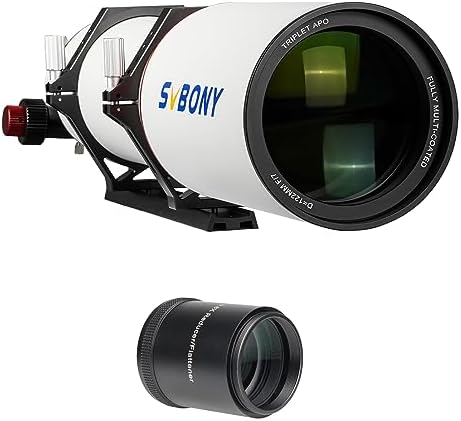
This bundle adds a 0.8X focal reducer to the SV550 122mm APO for prime focus astrophotography. It corrects field curvature and improves edge quality significantly.
We may earn a commission when you buy through this link, at no additional cost to you.
The SV209 flattener enhances imaging quality and shooting efficiency for the edge of the field of view. Its design is specific for the SV550 122mm F7 refractor.
The telescope features a 122mm aperture that gathers more light for detailed deep sky targets. Internal baffling ensures high contrast and sharpness throughout.
Ideal for enthusiasts seeking a wider field without sacrificing resolution. This package offers a comprehensive solution for wide-field deep sky imaging.
The 0.8X focal reducer corrects field curvature and provides a wider field for astrophotograph effectively.
Improves imaging quality and shooting efficiency of the edge of the field of view for consistent results.
We may earn a commission when you buy through this link, at no additional cost to you.
The SVBONY SV550 122mm Kit offers a compact refractor design with a 122mm aperture for clear detailed images. It is designed for easy carry into carrying cases.
We may earn a commission when you buy through this link, at no additional cost to you.
Its FPL-51 triplet lens reduces aberration for sharp deep sky photography and observation. The included SV209 reducer helps correct field curvature effectively for imaging.
A portable handle and comfortable dovetail base allow easy movement of the telescope. It gathers more light for fainter deep sky objects due to the aperture.
This kit is ideal for travelers needing a larger aperture option. Its portable features make setup and takedown efficient for field use.
Offers more clear and detailed images suitable for deep sky photography and observation of faint objects.
Portable handle and dovetail base make carrying and moving the telescope easy for field setup.
We may earn a commission when you buy through this link, at no additional cost to you.
This kit combines the SV550 80 F6 OTA with a SV209 flattener to prevent fringe field curvature issues. It produces sharp and clear images for observers and imagers.
We may earn a commission when you buy through this link, at no additional cost to you.
The ultra wide band fully multilayer coated lens prevents irritating reflections. The image is inverted when used with an eyepiece which is normal for refractors.
A comfortable and convenient carrying handle improves the safety factor during installation. Adjusting the handle position ensures easy and secure handling of the OTA.
Perfect for visual observers who want edge sharpness and a portable setup. This bundle offers a balanced solution for both viewing and basic imaging.
The SV209 effectively improves the image quality problem of SV550 OTA fringe field curvature for clear edges.
Ultra wide band fully multilayer coated lens brings you bright and clear images with sharp detail.
We may earn a commission when you buy through this link, at no additional cost to you.
This bundle provides a complete guiding setup with the SV550 122mm APO and a dedicated guide scope and camera. It features a high sensitivity 1.23-megapixel color camera.
We may earn a commission when you buy through this link, at no additional cost to you.
The compact camera uses a 1/3 CMOS sensor perfect for autoguiding or planetary imaging. It allows tight tracking of faint guide stars with low read noise.
The SV550 aperture gathers more light for clear detailed images suitable for deep sky photography. Internal design ensures excellent contrast and sharpness for targets.
Ideal for those ready to start advanced astrophotography without separate purchases. This bundle simplifies the guiding process for serious imaging enthusiasts.
High peak QE and low read noise allow tight tracking of faint guide stars for precise guiding.
Gathers more light and offers clear detailed images suitable for deep sky photography and observation.
We may earn a commission when you buy through this link, at no additional cost to you.
Choosing the right apochromatic refractor depends on your specific needs for visual observation or astrophotography. This guide covers key factors to consider.
Aperture determines the amount of light a telescope can gather. Larger apertures like 102mm or 122mm reveal fainter deep sky objects and provide brighter views.
For deep sky imaging a larger aperture helps reach higher limiting magnitudes. For visual use consider your mount's capacity and transport needs.
APO telescopes use specialized glass like FPL-51 or FCD1 HOYA to minimize color fringing. Triplet designs generally offer better color correction than doublets.
Air-spaced optics reduce internal reflections and improve contrast. Look for coatings that enhance light transmission for sharper images.
Focal ratio affects exposure times and field of view. Faster scopes around f/6 to f/7 are easier for deep sky imaging. Slower ratios provide higher magnification for planets.
Shorter focal lengths make telescopes more portable. Ensure the length fits your mount and observation space comfortably.
A flat field ensures sharp stars across the entire sensor or eyepiece. Some models are self-flattening while others require a separate field flattener.
Check if a bundle includes a flattener to avoid extra costs. Edge quality is critical for wide-field imaging results.
Ensure your mount can handle the telescope's weight. Look for dovetail plates like Vixen or Losmandy that fit standard saddles.
Heavier scopes require sturdy mounts for stable tracking. Check the included base and handle for transport convenience.
Travel astronomy requires lightweight scopes that fit in cases. Lightweight materials like magnesium can reduce load without sacrificing rigidity.
Consider how easy it is to carry and set up. Compact designs are best for spontaneous stargazing sessions.
A smooth dual-speed focuser with a 1:10 ratio allows precise focus adjustments. Look for models with sufficient travel for accessories like filter wheels.
Field rotators help align cameras without rotating the tube. This feature simplifies framing and composition during imaging.
Bundles often include essential accessories like field flatteners or guide scopes. Assess what you already own before buying separate items.
Higher costs may be worth it for complete solutions. Consider long-term value and customer support options.
Allow your telescope to acclimate to outdoor temperatures before observing. This prevents tube currents that can distort images and reduce clarity.
Use dew heaters or dew shields to prevent moisture on the objective lens. Clean optics only with appropriate tools and fluids to avoid scratching coatings.
Store the telescope in a dry place to prevent mold and corrosion. Collimate the optics periodically to ensure optimal performance and sharp star images.
An apochromatic refractor uses specialized glass and multiple lens elements to minimize chromatic aberration. This ensures sharp true-color images without purple fringing on bright objects.
Triplet lenses typically offer better color correction and contrast than doublets. They use three elements including low dispersion glass to reduce aberrations effectively.
If imaging with a camera a field flattener may be required to correct curvature. Some scopes include self-flattening designs which save extra costs and accessories.
Choose a mount rated for at least the telescope's weight. Stable tracking is essential for clear visual views and sharp images over time.
Use a blower to remove dust before wiping. Clean gently with lens tissue and proper solution to avoid damaging delicate coatings on the lens.
Air-spaced designs reduce internal reflections and improve contrast. They help prevent stray light from affecting image quality during observation.
Many APO refractors are designed for portability with lightweight materials. Look for models with carrying handles and compact dimensions for easy transport.
Astronomy cameras with low noise and good sensitivity work best. Ensure compatibility with adapters for full-frame or half-frame sensors.
We have reviewed ten top apochromatic refractors offering various options for visual and imaging use. The SVBONY SV550 APO 80mm stands out as a top all-rounder for quality and value.
Prioritize aperture and optical quality based on your targets. Whether you choose the Askar 71F or the SVBONY SV503 ensure it matches your mount and needs.
Prices and availability may change so check current listings before purchasing. Always consider accessories and long-term goals when selecting your telescope.